INDONESIA

Indonesia Payroll & HR Compliance Guide

HIGHLIGHTS

HR Forte simplifies Indonesia payroll compliance with full statutory coverage.

  • BPJS Ketenagakerjaan contributions (JKK, JKM, JHT, JP)
  • BPJS Kesehatan (health insurance) employer and employee contributions
  • Monthly income tax withholding — PPh 21 using the TER method
  • Tunjangan Hari Raya (THR) mandatory religious holiday allowance
  • Provincial minimum wage (UMP/UMK) compliance
  • Automated eLeave, eClaims, and payslips
  • Compliance-backed payroll calculations

BIG PICTURE

What Employers Need to Know About Payroll in Indonesia

Payroll in Indonesia requires employers to manage BPJS Ketenagakerjaan (employment social security), BPJS Kesehatan (national health insurance) contributions, monthly income tax withholding (PPh 21) under the TER (Tarif Efektif Rata-rata) system, and mandatory allowances in accordance with regulations from the Direktorat Jenderal Pajak (DJP), the BPJS authorities, and the Ministry of Manpower (Kementerian Ketenagakerjaan / Kemnaker).

Payroll accuracy depends on provincial minimum wage compliance, correct benefit classifications, and timely statutory reporting.

Indonesia1

Key Payroll Components in Indonesia

Statutory Contributions

Employers in Indonesia are required to manage multiple statutory obligations across two main social security schemes:


BPJS Ketenagakerjaan (Employment Social Security)

  • JKK — Work Accident Insurance: Employer-funded; rates range from 0.24% to 1.74% of salary based on business sector and risk classification.

  •  

    JKM — Death Insurance: Employer contribution of 0.30% of salary.

  •  

    JHT — Old Age Savings: Employer contributes 3.7% and employee contributes 2% of salary.

  •  

    JP — Pension: Employer contributes 2% and employee contributes 1% of salary, subject to government-set salary ceilings reviewed periodically.

BPJS Kesehatan (National Health Insurance)

  • Employer contributes 4% and employee contributes 1% of salary, subject to maximum salary caps set by the government.

  •  

    Dependants are covered under the employee's membership, subject to registration requirements.

Tunjangan Hari Raya (THR — Religious Holiday Allowance)

  • Mandatory annual bonus equivalent to one month's salary for employees with 12 or more months of service.

  •  

    Employees with less than 12 months receive a pro-rated THR amount.

  •  

    THR must be paid at least 7 days before the relevant religious holiday (Eid al-Fitr for Muslim employees; other holidays for others).


Provincial Minimum Wage (UMP / UMK)

  • Employers must comply with the provincial minimum wage (UMP) or the regency/city minimum wage (UMK) where applicable.
  • Minimum wages are reviewed and updated annually by each regional government.
  • Multi-region employers must track and apply the correct minimum wage for each location.

Monthly Income Tax Withholding (PPh 21 / TER)

Indonesia operates a monthly income tax withholding system under PPh 21. Since 2024, the TER (Tarif Efektif Rata-rata) method has been implemented to simplify monthly tax calculations for both employers and employees.

Key considerations:

  • Monthly tax is calculated by applying the applicable TER rate (based on PTKP — non-taxable income threshold and income category) to the employee's gross monthly income.

  •  

    A year-end reconciliation in December uses the actual annual progressive tax brackets (5%, 15%, 25%, 30%, 35%) to finalise the employee's total annual tax liability.

  •  

    Employers must submit monthly tax returns (SPT Masa PPh 21) to the DJP each month and perform the annual reconciliation.

  •  

    Employees are required to have an NPWP (Nomor Pokok Wajib Pajak — Tax Identification Number) for payroll processing. Those without an NPWP are subject to a 20% surcharge on their standard tax rate.

  •  

    Annual tax returns (SPT Tahunan) must be filed by employees by the relevant deadline, supported by the 1721-A1 form provided by employers.

    •  

Payroll Filings and Reporting Obligations

Employers must ensure timely submissions to the relevant authorities, including:

  • Monthly BPJS Ketenagakerjaan contribution reports and payments through the BPJS Ketenagakerjaan employer portal.

  •  

    Monthly BPJS Kesehatan contribution payments via the BPJS Kesehatan online system.

    Monthly PPh 21 withholding returns (SPT Masa PPh 21) submitted to the DJP via the e-Filing system.

  •  

    Annual tax reconciliation report and provision of the 1721-A1 form to each employee.

  •  

    THR payment reporting and certification submitted to the Kemnaker task force prior to the relevant religious holiday.

  •  

    Employee payslip issuance and payroll record retention in accordance with Indonesian Labour Law (Undang-Undang Ketenagakerjaan).

    Late or incorrect submissions may result in administrative sanctions, interest charges, and audit exposure from the DJP, BPJS authorities, or Kemnaker.

Common Payroll Challenges in Indonesia

Many employers face recurring payroll issues due to:

  • Managing multiple BPJS contribution components (JKK, JKM, JHT, JP, Kesehatan) with different rates, salary ceilings, and submission deadlines.

  •  

    Correctly applying TER rates under the updated PPh 21 system and performing accurate year-end reconciliation.

  •  

    Tracking annual UMP/UMK updates across multiple provinces or regions for geographically dispersed workforces.

  •  

    Ensuring accurate THR calculations and timely disbursement ahead of religious holidays with strict government deadlines.

  •  

    Handling NPWP compliance, including the 20% surcharge for employees without a valid Tax Identification Number.

  •  

    Maintaining consistent payroll records across locations for DJP audits and Kemnaker inspections.

    "These issues increase compliance risk and administrative workload for HR and finance teams."

HR FORTE COMPLIANCE

How HR Forte Supports Indonesia Payroll Compliance

HR Forte supports payroll operations in Indonesia by:
•    Automating BPJS Ketenagakerjaan (JKK, JKM, JHT, JP) and BPJS Kesehatan contribution calculations based on current statutory rates and salary caps.
•    Applying the correct PPh 21 TER rates for monthly tax withholding and performing year-end reconciliation against annual progressive tax brackets.
•    Managing THR eligibility determination, pro-rata calculations, and disbursement scheduling.
•    Tracking and applying the correct UMP/UMK for each province or region.
•    Integrating payroll with attendance, leave, and claims for full workforce visibility across locations.
•    Maintaining structured payroll records and audit trails for DJP, BPJS, and Kemnaker compliance.

Payroll workflows are standardised and traceable to reduce dependency on manual processes and spreadsheets.
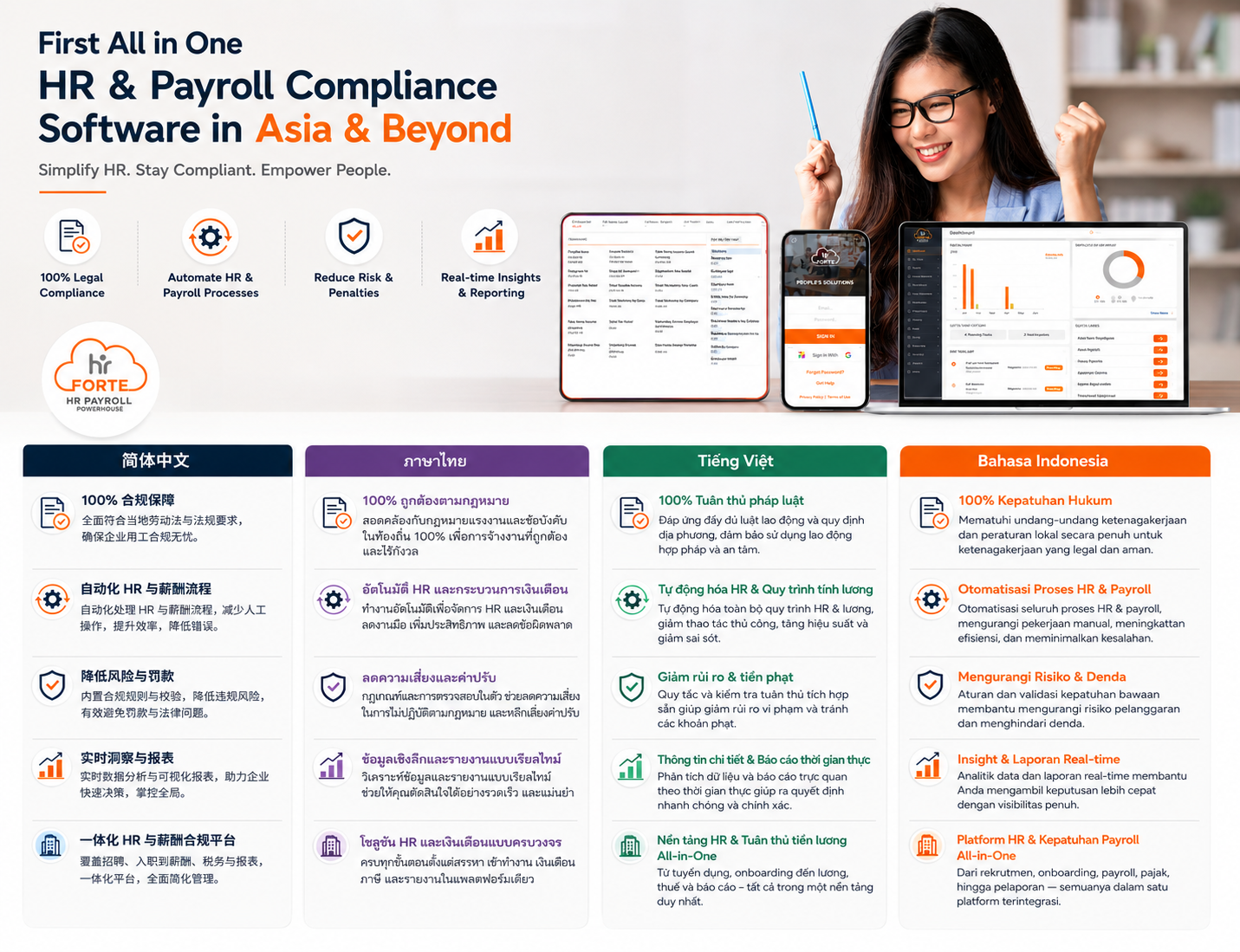
HR Forte Multi countries multi languages payroll compliance Saas systeem for Asia
FAQ

Have questions?

What statutory contributions are required for payroll in Indonesia?

Employers in Indonesia must manage mandatory contributions to two primary social security programs: BPJS Ketenagakerjaan (covering work injury [JKK], death [JKM], old-age [JHT], and pension [JP]) and BPJS Kesehatan for healthcare. Additionally, employers are legally required to pay the Tunjangan Hari Raya (THR), a mandatory annual religious holiday allowance, to all eligible employees.

How is monthly employee income tax calculated and deducted in Indonesia?

Monthly employee income tax in Indonesia is withheld by employers using the PPh 21 framework under the TER (Tarif Efektif Rata-rata) average effective tax rate method. Employers apply these monthly withholding rates throughout the calendar year and must perform a final year-end reconciliation in December using the progressive tax rates and the employee's actual annual income minus their non-taxable income threshold (PTKP).

How frequently do payroll regulations and compliance laws change in Indonesia?

Payroll regulations in Indonesia change frequently, with key updates typically occurring annually. Changes generally impact Provincial Minimum Wages (UMP/UMK), BPJS contribution salary ceilings, updated TER tax rate tables, and adjustments to non-taxable income (PTKP) thresholds. Employers are required to track both national legislative updates and regional or provincial decrees to maintain compliance.

What are the legal and financial penalties for payroll non-compliance in Indonesia?

Payroll errors or delays in Indonesia result in administrative fines, interest surcharges, and potential legal sanctions from regulatory bodies including the Directorate General of Taxes (DJP), BPJS authorities, and the Ministry of Manpower (Kemnaker). Specific compliance triggers include incorrect or late PPh 21 tax filings, delayed BPJS contributions, underpayment of regional minimum wages, or missed THR holiday allowance deadlines.

What is the best way for companies to minimize payroll compliance risks in Indonesia?

Companies can minimize compliance risks by deploying localized, native payroll systems that automatically calculate BPJS contributions, apply correct TER-based PPh 21 tax withholdings, track regional minimum wage updates, and schedule mandatory THR payments. Maintaining automated, comprehensive audit trails across all payroll records ensures readiness for regulatory inspections.

Why HR Forte in Indonesia?

Indonesia's payroll involves multi-layer statutory obligations — from BPJS Ketenagakerjaan and Kesehatan contributions and PPh 21 tax withholding to THR payments and regional minimum wages across dozens of provinces.

HR Forte automates these calculations across every component, ensuring full compliance with DJP, BPJS, and Kemnaker requirements every payroll cycle.