
Asia Payroll & HR Compliance Hub
Your authoritative resource for navigating payroll complexities across Asia. Expert guides, country-specific insights, and practical tools to ensure compliance.
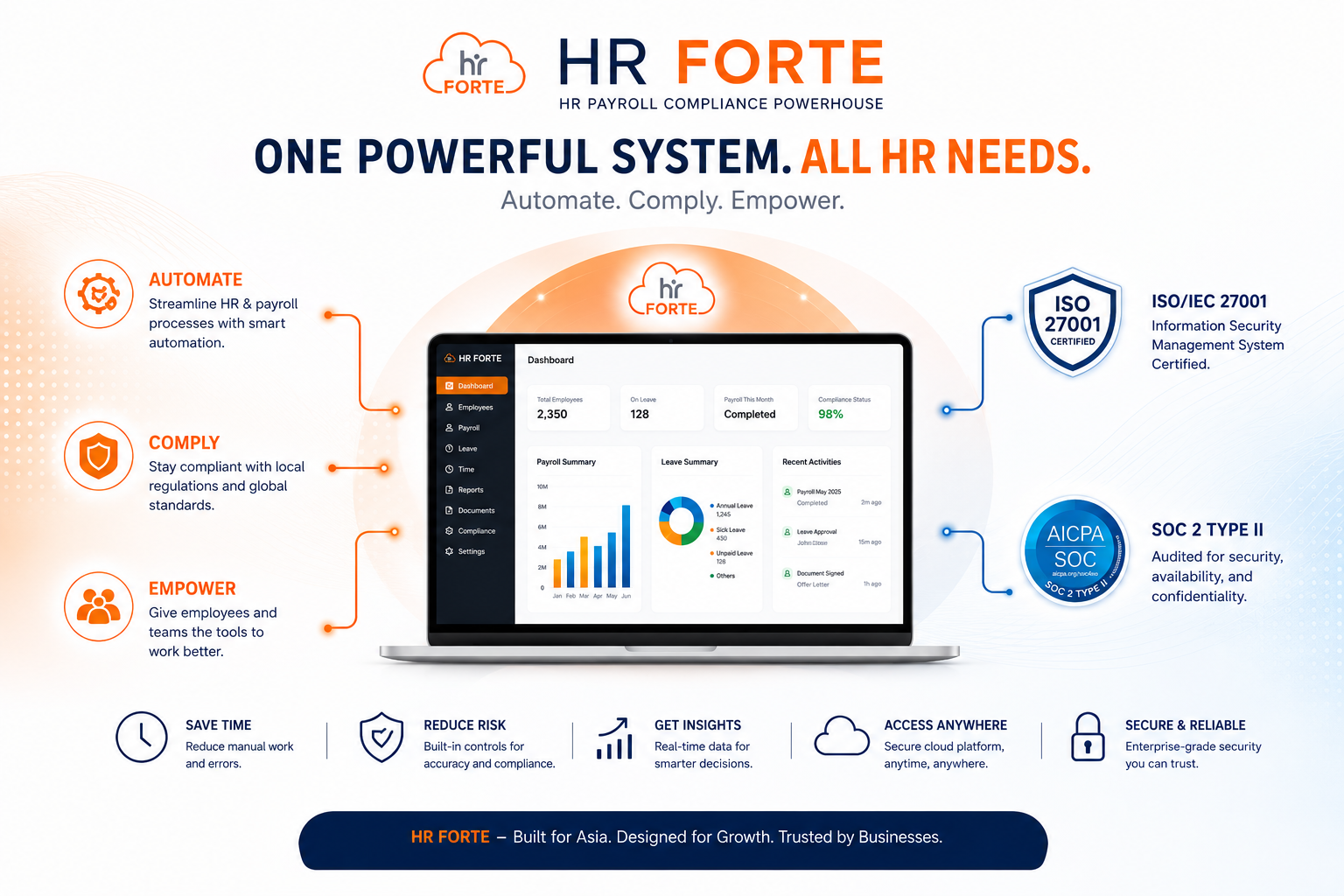
Why HR Forte is trusted for Asia payroll and statutory compliance?
-
Built specifically for Asia payroll and statutory complexity
-
Covers 7+ APAC countries with country-specific logic
-
Used by SMEs, regional HQs, and payroll service providers across Asia
-
Compliance logic backed by verified local regulations
-
Continuously updated for regulatory changes
What is Asia HR Payroll Compliance?
Asia payroll compliance refers to the legal and regulatory requirements businesses must follow when processing employee wages across Asian markets. It encompasses statutory contributions (CPF, EPF, social insurance), tax withholdings, mandatory benefits, and local filing obligations. Compliance is challenging in Asia due to fragmented regulations, frequent legislative changes, language barriers, and varying interpretations of labor laws across jurisdictions.
Why Asia Payroll is Different?
Managing payroll across Asian markets presents unique challenges that require specialized knowledge and localized expertise.
Statutory Caps & Ceilings
Each country sets unique contribution caps for social security, pension funds, and health insurance that change annually.
Frequent Legislative Changes
Asian governments regularly update labor laws, tax rates, and compliance requirements—often with short notice periods.
Complex Local Filings
Mandatory monthly, quarterly, and annual submissions to multiple government agencies in local languages and formats.
Varied Interpretation
Labor law interpretation differs between regions, industries, and even individual government officers.
Common Asia Payroll Compliance Questions Answered
Why is payroll compliance more complex in Asia than in other regions?
Payroll compliance in Asia is complex because each country operates its own statutory framework for tax, social security, labor law, and reporting, with no regional standardisation. Employers must manage country-specific contribution schemes, wage ceilings, exemptions, filing formats, and enforcement practices, often in different languages and with frequent regulatory changes.
How do payroll rules differ across Asian countries?
Payroll rules differ significantly across Asian countries in how employee taxes, employer contributions, and statutory benefits are calculated and reported. For example, Singapore applies CPF and income reporting forms such as IR8A, Malaysia uses EPF, SOCSO, EIS, and PCB tax, while Vietnam applies PIT, social insurance, health insurance, unemployment insurance, and region-based minimum wages. Each country has unique thresholds, caps, and filing requirements.
How often do payroll regulations change in Asia?
Payroll regulations in Asia change frequently, often annually and sometimes mid-year. Governments regularly update contribution rates, wage ceilings, tax brackets, minimum wages, and reporting obligations. Without continuous monitoring, employers risk applying outdated rules, which can result in incorrect payroll calculations and compliance breaches.
Can one payroll system handle multi-country Asia payroll?
Yes, one payroll system can handle multi-country Asia payroll, but only if it applies country-specific statutory logic rather than generic global rules. A compliant system must calculate payroll independently for each country, respecting local tax laws, social insurance schemes, wage limits, and reporting formats, while still allowing consolidated oversight across entities and regions.
What risks do companies face with incorrect statutory payroll?
Incorrect statutory payroll exposes companies to regulatory penalties, backdated contributions, audit findings, and reputational damage. Employees may receive incorrect tax records or benefit contributions, leading to dissatisfaction and disputes. Over time, repeated payroll errors increase compliance risk, operational cost, and loss of trust from both employees and authorities.
Why Payroll Errors Happen in Asia & How to Fix Them
Discover the root causes of payroll mistakes in Asian markets from statutory miscalculations to manual data entry errors and learn proven strategies to prevent them.
How Payroll Automation Reduces Errors for SMEs in Asia
Learn how small and medium enterprises across Asia are leveraging automation to eliminate payroll errors, save time, and ensure compliance.
How to Move from Excel Payroll to an Automated Payroll System
A step-by-step guide to transitioning from spreadsheet-based payroll to a modern, compliant payroll system without disrupting operations.
Country Snapshots
Quick overview of payroll requirements across key Asian markets.

Singapore
- CPF contributions
- IR8A filings
- Skills Development Levy
This guide covers statutory payroll compliance in Singapore, including CPF, IR8A, and SDL.

Malaysia
- EPF & SOCSO
- PCB tax deductions
- HRDF levy
This guide covers statutory payroll compliance in Malaysia, including EPF, Socso, PCB tax and HRDF levy.

Vietnam
- Social, Health & Unemployment insurances
- Regional minimum wages
- PIT declarations
This guide covers statutory payroll compliance in Vietnam, including SHUI, regional minimum wages and PIT tax.

Thailand
- Social Security Fund
- Provident fund
- Withholding tax
This guide covers statutory payroll compliance in Thailand, including SSF, provident fund and withholding tax.

Hong Kong
- MPF contributions
- IR56B filings
- No payroll tax
This guide covers statutory payroll compliance in Hong Kong, including MPF, IR56B and expats leaving HK.

Philippines
- SSS, PhilHealth, Pag-IBIG
- 13th month pay
- BIR compliance
This guide covers statutory payroll compliance in the Philippines, including SSS, PhilHealth, Pag-IBIG, bonus pay and BIR tax.

Cambodia
- NSSF contributions
- Seniority payments
- Tax on salary
This guide covers statutory payroll compliance in Cambodia, including NSSF, Seniority payments and salary tax.

Indonesia
- BPJS Ketenagakerjaan & BPJS Kesehatan contributions
- Progressive income tax (PPh 21) with annual reconciliation
- Frequent regulatory updates and reporting obligations
This guide covers statutory payroll compliance in Indonesia, including BPJS Ketenagakerjaan & BPJS Kesehatan contributions and PPh21.

(Coming soon)
Compliance Checklists
Practical checklists to keep your payroll operations on track.
Payroll
Monthly Payroll Health Check
A comprehensive checklist to verify statutory calculations, deductions accuracy, and submission deadlines each cycle.
-

Contribution rates
-
Tax calculations
-
Leave balances
-
Submission dates
Year-End
Year-End Compliance Checklist
Essential tasks to complete before fiscal year-end, including annual filings, bonus calculations, and audit preparation.
-
IR8A/IR21 forms
-
Annual returns
-
13th month pay
-
Leave encashment
Data Migration
Excel Migration Checklist
Step-by-step validation points when transitioning from spreadsheet payroll to an automated system.
-
Data mapping
-
Parallel runs
-
Calculation validation
-
User guides
Payroll & Compliance Tools
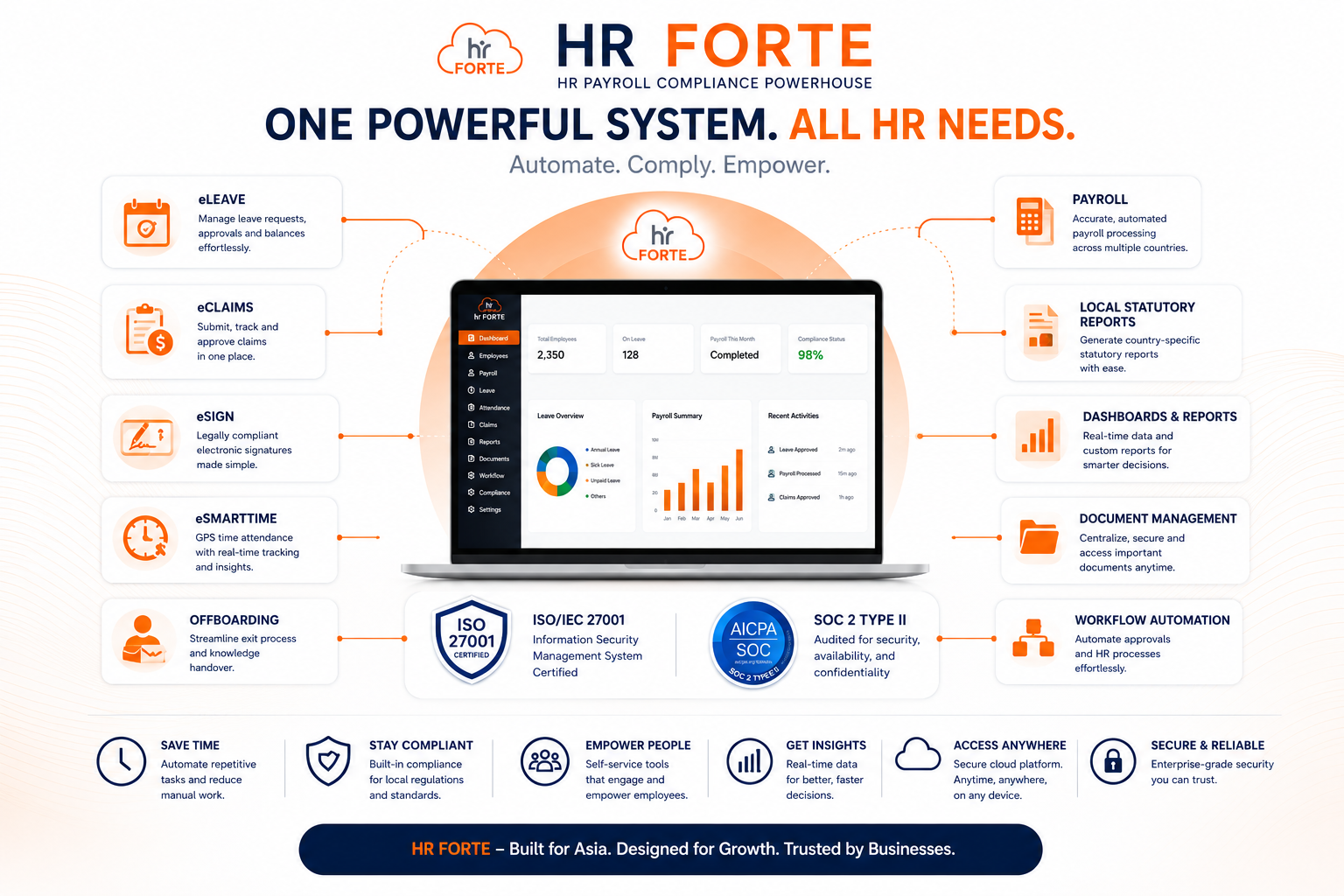
Automated Payroll Processing
Smart Payroll
End-to-end payroll automation with built-in compliance for Singapore, Malaysia, Vietnam, and more. Calculate statutory contributions, generate payslips, and submit filings automatically.
-
Auto-calculations
-
Multi-country
-
Statutory filings
-
Payslip generation

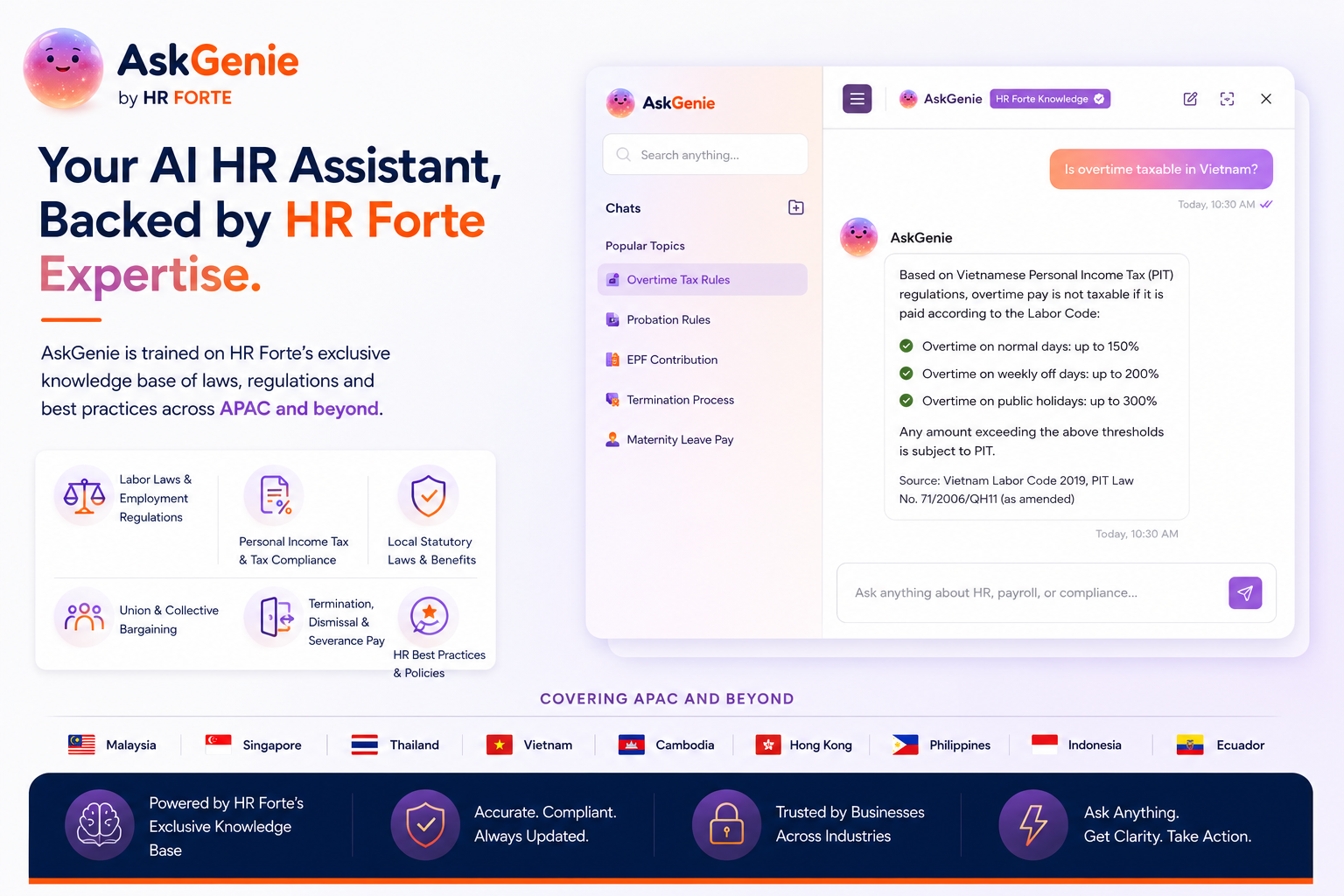
AskGenie
Get instant answers to payroll and HR compliance questions. AskGenie understands local regulations and guides you through complex scenarios with context-aware recommendations.
-
Natural language
-
Real-time guidance
-
In-app navigation
-
Compliance alerts
.png?width=500&height=500&name=HRF%20-%20Image%20AskGenie%20(3).png)
Have questions?
Why do global payroll tools struggle with Asia compliance?
Many global tools are built for US or Europe payroll assumptions and may not support Asia’s statutory caps, local filing formats, frequent regulatory updates, and country-specific calculation logic.
What is statutory payroll compliance in Asia?
It is the accurate application of local tax and social security rules, required calculations, and filings according to each country’s regulations and reporting formats.
How can SMEs reduce payroll errors without hiring a payroll specialist?
SMEs typically reduce errors by using rule-based payroll automation with embedded statutory logic, validation checks, and standardized approval workflows.
How can companies standardize payroll across multiple Asian countries?
Use a centralized payroll platform that applies country-specific rules per entity, standardizes workflows and reporting, and supports local statutory outputs.
Can AI answer payroll compliance questions accurately in Asia?
AI can be helpful when it is trained on statutory rules and kept updated with regulatory changes. For compliance decisions, AI should be paired with embedded local payroll logic and auditable workflows.
Ready to Simplify Your Asia Payroll?
Join thousands of businesses using HR Forte to automate payroll compliance across Asia. Get started with Smart Payroll or ask our AI assistant for guidance.