Recognized by LHDN, HR Forte simplifies Malaysian payroll compliance.
-
-
EPF, SOCSO, and EIS contributions
-
Monthly tax deductions (MTD/PCB)
-
Automated eLeave, eClaims, and payslips
-
Compliance-backed payroll calculations
-
What Employers Need to Know About Payroll in Malaysia
Payroll in Malaysia requires employers to calculate and report statutory contributions, monthly tax deductions, and employee entitlements in accordance with regulations issued by LHDN, EPF, SOCSO, and EIS. Payroll accuracy depends on correct salary classification, statutory thresholds, and timely submissions.

Key Payroll Components in Malaysia
Statutory Contributions
Employers in Malaysia are required to manage multiple statutory contributions:
-
Employees Provident Fund (EPF)
Employer and employee contributions based on statutory rates and salary thresholds. -
Social Security Organisation (SOCSO)
Coverage depends on salary band and employee eligibility. -
Employment Insurance System (EIS)
Mandatory for eligible employees to provide income replacement support.
Contribution rates and thresholds may change and must be applied correctly for every payroll cycle.
Monthly Tax Deductions (MTD / PCB)
Malaysia operates a Monthly Tax Deduction (MTD/PCB) system, where employers withhold income tax at source.
Key considerations:
-
Tax deductions are calculated based on income level and relief eligibility
-
Adjustments may be required for bonuses, variable pay, or leave deductions
-
Incorrect MTD calculations can lead to under- or over-withholding

Payroll Filings and Reporting Obligations
Employers must ensure timely submissions to the relevant authorities, including:
-
Monthly EPF, SOCSO, and EIS contributions
-
Monthly PCB submissions to LHDN
-
Year-end tax forms and reconciliations
-
Employee payslip issuance and record retention
Late or incorrect submissions may result in penalties or audit exposure.
Common Payroll Challenges in Malaysia
Many employers face recurring payroll issues due to:
-
Manual or spreadsheet-based payroll processing
-
Incorrect application of statutory contribution ceilings
-
Errors in PCB calculations for variable income
-
Lack of audit trail for payroll adjustments
-
Difficulty tracking regulatory changes
These issues increase compliance risk and administrative workload.

How HR Forte Supports Malaysian Payroll Compliance
HR Forte supports payroll operations in Malaysia by:
-
Applying EPF, SOCSO, and EIS rules consistently
-
Automating MTD/PCB calculations based on payroll data
-
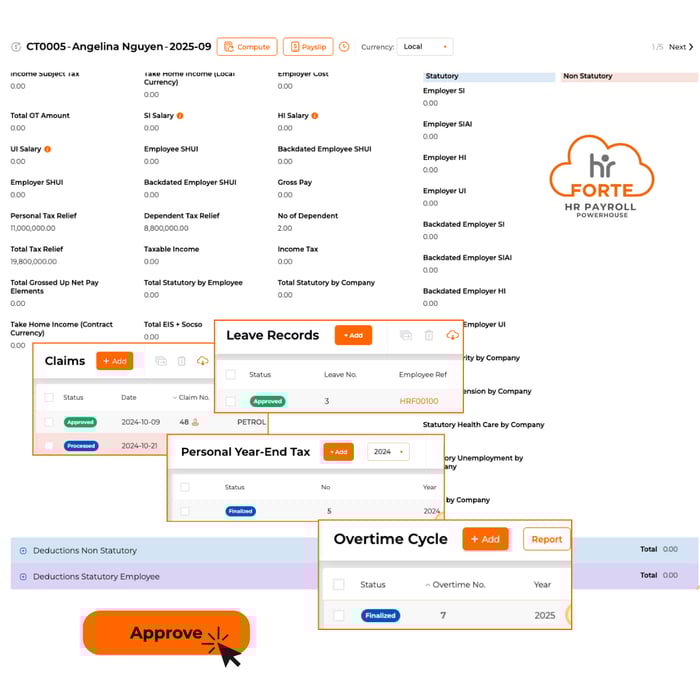
Integrating payroll with attendance, leave, and claims
-
Providing compliance-backed payroll calculations
-
Maintaining structured payroll records for audits
Payroll workflows are standardised and traceable to reduce dependency on manual processes.
Need clarification?
What statutory contributions are required for payroll in Malaysia?
Employers must manage EPF, SOCSO, EIS, and HRD Corp levy contributions. Under the latest regulations, EPF is now mandatory for foreign workers (at a 2% rate), and SOCSO/EIS contributions are calculated up to an increased monthly wage ceiling of RM6,000.
Is income tax deducted monthly in Malaysia?
Yes. Employers must withhold Monthly Tax Deductions (MTD/PCB) from employee salaries and submit them to LHDN by the 15th of the following month. Current MTD specifications reflect the expanded tax reliefs introduced in the latest national budget, including updated limits for medical, childcare, and lifestyle reliefs.
Do payroll rules in Malaysia change frequently?
Yes. Recent years have seen frequent changes, such as the minimum wage hike to RM1,700, the expansion of SOCSO to include a 24-Hour Non-Employment Injury Scheme, and mandatory retirement fund requirements for expatriates. Rates and thresholds must be closely monitored.
Can payroll errors lead to penalties in Malaysia?
Yes. Applying outdated contribution rates—such as failing to cap SOCSO/EIS at the RM6,000 ceiling or missing the foreign worker EPF mandate—will result in late payment interest (6% per annum for SOCSO), statutory penalties, or severe fines up to RM10,000 and imprisonment.
How can employers reduce payroll compliance risk in Malaysia?
By utilizing localized payroll systems or HRMS software that automatically updates to reflect current LHDN tax tables, the EPF Third Schedule, and SOCSO wage bands, while maintaining clear electronic audit trails.
Why HR Forte in Malaysia?
Malaysia’s payroll requires accurate statutory contributions and frequent updates. HR Forte automates EPF, SOCSO, EIS, and tax deductions — ensuring compliance and timely filings every month.